






Three Ways Producers Can Combat Fertilizer Costs
For many producers, fertilizer is more than just another operating expense—it’s the largest investment made each growing season.
While fertilizer prices have fluctuated over the past several years, affordability remains a significant challenge as farmers navigate compressed margins, geopolitical disruption, concentrated markets, and ongoing uncertainty across a range of sectors.
Much of the fertilizer cost conversation is centered around the why. As a nationwide farm lender focused on helping American agriculture succeed, AgAmerica is much more concerned with what can be done to manage the financial risk of high fertilizer costs.
In this article, we discuss three practical ways producers can combat fertilizer costs and improve financial resilience heading into future growing seasons.
Historical Trends of Fertilizer Costs and Impact on Farm Profitability
During a Senate Agriculture Committee hearing on fertilizer costs, witnesses noted that fertilizer can account for as much as 40 percent of crop input costs for some producers.
Right now, fertilizer cost spikes are occurring at a particularly challenging time. Farm income projections in 2026 are under pressure, relying heavily on farm program payments to prevent a substantial drop.
Although not the only contributing factor, the conflict involving Iran and disruptions surrounding the Strait of Hormuz have recently placed fertilizer costs and availability in the spotlight. Because of these events, discussions in Washington around fertilizer pricing, supply chain vulnerabilities, and market competition have been reignited.
But high fertilizer costs didn’t just begin in 2026. Prior to the U.S.-Iran conflict, prices for inputs like nitrogen fertilizers, anhydrous ammonia, and urea rose sharply in 2021 through 2022, due to an accumulation of pandemic-related disruption and Russia’s invasion of Ukraine in early 2022.
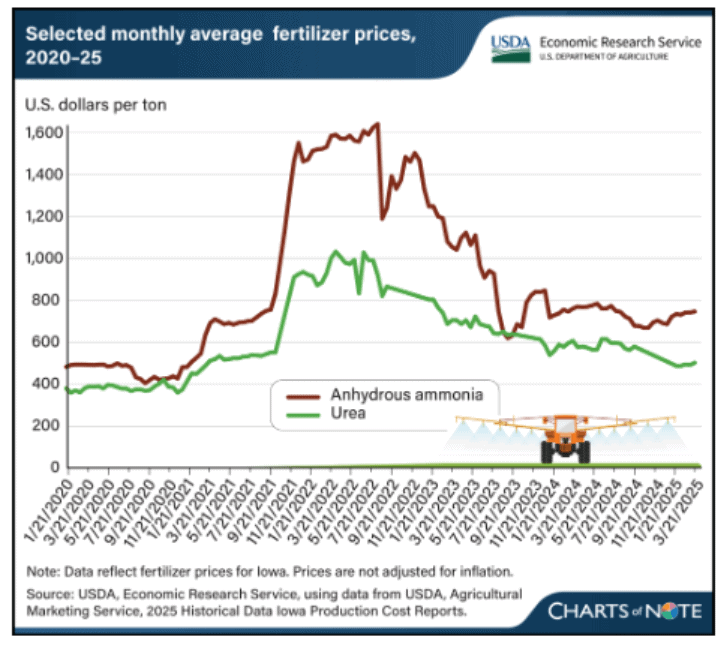
“One point that must be clearly understood is that today’s fertilizer price challenges did not begin with the recent conflict in Iran. While global tensions often draw attention to input markets, prices for inputs like fertilizer and fuel have been elevated for several years. The current situation is not a temporary disruption, it is the continuation of a longer trend that has steadily increased the cost of doing business in agriculture.”
– Eddie Melton, Kentucky Farm Bureau Federation
Three Ways to Manage Fertilizer Costs
When fertilizer prices rise, the ripple effects can include reduced profit margins, increased borrowing needs, and limited producers’ flexibility to respond to changing market conditions.
Whether it’s too much reliance on global markets, anti-competitive practices, or any of the other potential contributors that people argue over, the reality is that American producers have little control over fertilizer cost trends.
The good news is that there are steps you can take as a producer to help offset the financial impact.
1. Improve Fertilizer Efficiency to Maximize ROI Per Acre
In a high-cost input environment, efficiency becomes one of the most effective tools available to producers.
While fertilizer is essential for maximizing yield potential, not every application delivers equal return. Differences in soil health, field variability, and timing can significantly impact nutrient uptake and effectiveness.
Producers are increasingly relying on:
- Soil testing and nutrient mapping
- Variable-rate application technology
- Split applications to improve uptake efficiency
- Improved nutrient management planning
These approaches do not eliminate fertilizer costs, but they can help ensure that each dollar spent is contributing as directly as possible to yield and revenue potential.
2. Strengthen Purchasing Strategy to Reduce Exposure
Fertilizer pricing is highly sensitive to timing, global supply conditions, and seasonal demand cycles. As a result, purchasing decisions can have a meaningful impact on total input costs.
Producers who were able to secure fertilizer prior to the U.S.-Iran conflict, for example, were in a better financial position at the start of the 2026 planting season. Others are facing tougher decisions due to financial constraints, with roughly 70 percent of farmers report being unable to afford all the fertilizer they need.
Rather than kicking yourself for not knowing what the future had in store, there are lessons to be learned for future growing seasons. More specifically, pay attention to:
- Early purchase opportunities vs. cash flow needs
- Storage and logistics capacity
- Market timing risk during peak demand periods
Taking time to plan ahead when it comes to purchasing decisions can help reduce the likelihood of being forced into high-cost input windows at critical points in the growing season.
3. Protect Working Capital to Maintain Financial Flexibility
Even with strong efficiency and purchasing strategies, fertilizer costs ultimately come down to one key constraint—liquidity.
Fertilizer is a large upfront expense, and in years of elevated pricing, it can significantly increase the demand for working capital at the exact moment producers are making critical planting and production decisions.
Maintaining financial flexibility can help operations:
- Act quickly when input pricing opportunities arise
- Avoid forced purchasing decisions under cash pressure
- Preserve liquidity for other operational needs
- Better absorb year-to-year input cost volatility
In a volatile input environment, access to capital is not just a financial consideration—it is an operational tool that can influence timing, strategy, and overall profitability.
Combat High Fertilizer Costs with AgAmerica’s Flexible Financing Solutions
While efficiency and purchasing strategies can help manage exposure, maintaining strong working capital remains critical to making timely, confident decisions in uncertain conditions.
AgAmerica works alongside producers like you to provide flexible financing solutions that help preserve liquidity, support seasonal input needs, and strengthen long-term operational resilience.
Some examples of our innovative financing solutions include:
- Customizable terms that align with seasonal input and cash flow cycles
- Opportunities to restructure debt to improve liquidity when margins are tight
- Short-term, interest-only options for transitional periods
- Long-term solutions focused on strengthening overall financial resilience
If you’re ready to focus more on farming and less on financial constraints, contact us today to learn how AgAmerica can help.