





Using Government Payments for Farmers to Your Advantage
Does the recently announced Farmer Bridge Assistance Program fit into your 2026 financial plan?
After reaching historic highs in 2020, government payments for farmers are once again moving to the center of the farm income conversation with the announcement of the Farmer Bridge Assistance Program and Aid earlier this month.
With margins tight, trade disruptions lingering, and liquidity under pressure—particularly for grain producers—the federal government’s newly announced farmer aid package is set to play a meaningful role in 2026 financial planning for producers who qualify.
While this latest round of support offers important short-term relief, it also underscores a broader reality. Many producers are entering 2026 with limited financial flexibility and increasing reliance on government programs to bridge cash flow gaps.
How Government Payments for Farmers Impact the Farm Economy
Before this $12 billion Farmer Bridge Aid announcement, government payments for farmers were already projected to reach $40.5 billion in 2025, accounting for nearly 23 percent of total expected farm income. That figure sits just below the $45.6 billion distributed in 2020, when pandemic relief and trade assistance programs peaked.
The Farmer Bridge Aid suggests that government payments for farmers in 2026 are likely to follow a similar trajectory—providing temporary income stabilization at a time when market-driven profitability remains elusive.
The intent of these government payments for farmers is to provide interim relief between now and when 2025 ARC/PLC payments are expected in October 2026, offering producers short-term liquidity during a period of heightened financial strain. For many operations, particularly in the grain sector, these funds will help cover operating expenses, service existing debt, and safeguard working capital as the next production cycle approaches.
From a broader perspective, government payments for farmers play a direct role in supporting net farm income, stabilizing balance sheets, and indirectly influencing land values and credit availability. However, while these payments can ease near-term pressure, they are not a substitute for sustainable profitability.
Farmer Bridge Aid and Assistance Program Details
Details are still being finalized, but eligible producers are expected to begin receiving payments by the end of February 2026. Here’s what else we know.
Scope of Farmer Bridge Aid Funding
The USDA will devote up to $11 billion of the total farmer aid package specifically to the Farmer Bridge Assistance (FBA) Program for eligible row crop producers. The remaining $1 billion will be reserved for specialty crops (fruits, vegetables, nuts, sugar, etc.), though details and timelines for that portion are still under development. This has created uncertainty for many stakeholders who argue this isn’t nearly enough to offset the headwinds specialty crop growers are facing.
Eligibility Requirements
The FBA Program covers a wide range of row crops, including barley, chickpeas, corn, cotton, lentils, oats, peanuts, peas, rice, sorghum, soybeans, wheat, canola, flax, mustard, rapeseed, safflower, sesame, and sunflower.
It’s important to note that crop insurance linkage is not required to receive FBA payments, but USDA encourages growers to use broader risk-management tools made available under the recent farm bill updates. Double-crop acres are eligible, but prevented-plant acres will not qualify under current guidance.
Producers or legal entities must have an adjusted gross income (AGI) of $900,000 or less to be eligible. Payments are capped at $155,000 per person or legal entity.
Application and Deadlines
The main deadline for the USDA Farmer Bridge Assistance Program (FBA) has passed. Farmers needed to ensure their 2025 crop acreage reports were accurate and filed with the local Farm Service Agency (FSA) by December 19, 2025, at 5 p.m. ET. If already on file, no separate application is needed and payments are expected by February 28, 2026, for eligible producers.
Payment Calculation and Rates
Acreage reporting serves as the basis for calculating individual payment amounts, in conjunction with USDA cost-of-production data and World Agricultural Supply and Demand Estimates (WASDE) models. Payment formulas are based on a combination of planted acreage, cost-of-production estimates, and yield and price projections from USDA data.
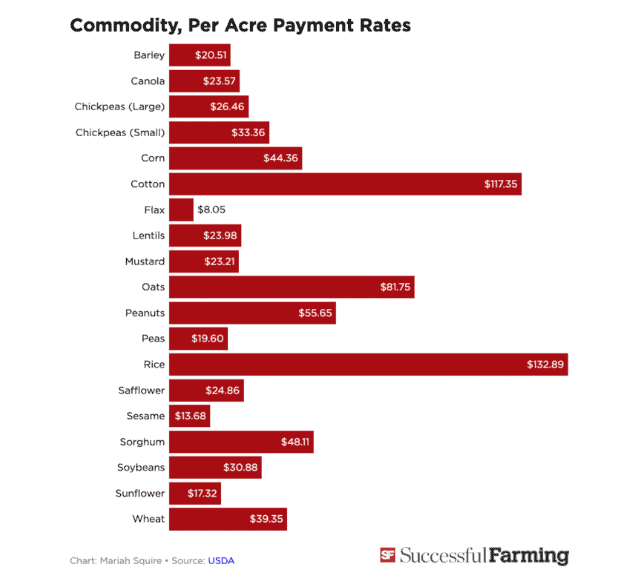
Based on these calculations, the highest payments will go to rice, cotton, and then oat farmers. According to the American Soybean Association, these Farmer Bridge Assistance payments will provide “needed relief”, but fall short of creating long-term stability.
Will There Be More Government Payments for Farmers in 2026?
Lawmakers and industry groups have already raised concerns that commodity sectors, such as specialty crops, dairy, and timber, remain largely underserved despite this recent announcement.
House Agriculture Committee Chair Glenn “GT” Thompson has indicated that Congress may need to provide at least $10 billion in additional farmer aid to supplement the current package, noting that while the program may improve access to credit for some producers, “it’s not enough.”
How Producers Can Use Government Payments Wisely
While relying on government payments is not the preferred method of earning income, leveraging it effectively can better position you for market-generated returns in the long run. The best way to use government payments is as a bridge, not a business model.
Effective ways to use government payments for farmers include:
- Paying off debt (prioritize high and variable rates)
- Strategic investments that prioritize ROI and lower costs
- Supporting refinancing or restructuring decisions
Bottom line: Relying too heavily on recurring government support without addressing cost structure, debt alignment, or revenue risk can leave operations vulnerable once assistance tapers off.
Secure Your Operation Outside of Government Support
Government payments for farmers are likely to remain part of the farm income landscape in 2026. Ongoing uncertainty surrounding trade, interest rates, and global demand makes it more crucial than ever to align anticipated federal support with a long-term financial strategy.
AgAmerica works with producers as a strategic financial partner, offering custom land-backed financing designed to:
- Preserve liquidity
- Align debt structure with revenue cycles
- Strengthen long-term financial resilience
By integrating short-term relief into a broader plan, producers can turn temporary assistance into lasting stability. Contact an AgAmerica lending specialist to discuss how government payments fit into your broader financial plan.