






The Strength of America’s Food Supply Starts with Financially Strong Farms
National Farmer’s Day is an opportunity to recognize American farmers and ranchers for all that they do to keep productive land in operation.
Every product on a grocery store shelf begins with a producer making decisions months or even years before receiving a return. Farmers and ranchers invest in land, labor, equipment, seed, feed, fertilizer, energy, storage, and other operating costs while navigating weather uncertainty, volatile markets, interest expenses, labor constraints, and shifting supply chains.
Few industries outside of agriculture operate under such a complex mix of financial, operational, and environmental risks while producing goods the world depends on every day.
That reality highlights an important but often overlooked connection—the strength of America’s food system ultimately depends on the financial strength of the domestic farm operations producing it.
Why Domestic Food Production Matters Beyond the Farm Gate
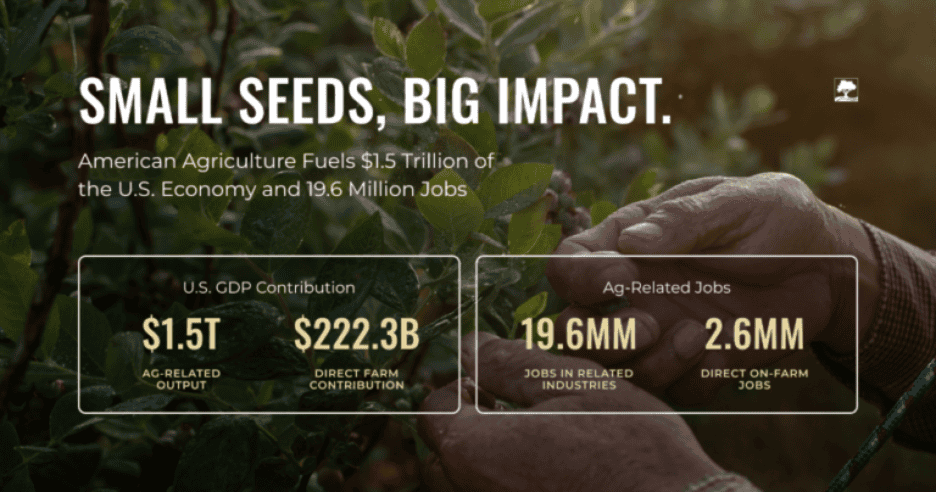
The economic footprint of U.S. food production extends well beyond the farm gate. Agricultural activity supports equipment dealers, input suppliers, veterinarians, mechanics, processors, transportation providers, storage operators, employees, and more. Farm payroll, land stewardship, capital improvements, and local purchasing help sustain communities where agriculture is a central part of the economy.
Domestic production also provides productive capacity that can be used when international supply patterns become less predictable. A strong domestic base does not require the United States to isolate itself from global markets. It gives the country more flexibility while trade expands consumer choice, opens markets, and moves food and agricultural products across regions and borders.
The Role of Agricultural Finance in Protecting Domestic Food Production
Domestic food production matters because it supports a dependable food supply, rural economies, and the country’s ability to respond when weather, transportation, trade, or geopolitical disruptions affect global supply chains.
Of course, agricultural financing is not a universal answer to structural market pressure, but it can be used as a tool to support producers through factors beyond their control. When producers have sufficient liquidity and appropriately structured debt, they have more room to maintain assets, absorb volatility, invest in efficiency, and continue producing over the long term.
The financial condition of one farm does not determine the strength of the nation’s entire food system. But across thousands of operations, decisions about maintenance, investment, production mix, and succession can influence the capacity available to produce food in the future.
How Financial Pressure Has Impacted Domestic Production Over Time
Farm financial pressure rarely affects production capacity through one event alone. More often, the impact is a result of multiple factors that have compounded over time. This is what we’re seeing in the current U.S. ag market.
Elevated input costs, lower commodity prices, interest expenses, labor challenges, trade uncertainty, weather volatility, disease, water constraints, and import competition have all played a role in the narrow margins many producers are facing today. If that pressure persists, they may have less working capital available to replace assets, invest in infrastructure, adopt technology, or withstand a poor production cycle.
The risk that comes with financial pressure is not just the result of one difficult year. Deferred maintenance, reduced investment, and less financial flexibility can make it harder for an operation to adapt and evolve when the next disruption arrives.
The numbers speak for themselves.
- Since 2000, U.S. vegetable acreage declined 41 percent and production declined 24 percent.
- During that same time, U.S. fruit acreage, including citrus, declined 37 percent, while production declined 48 percent.
- From 2002 to 2022, the U.S. lost an estimated 230,000 farms.
- Over that same period, we lost roughly 58 million acres of farmland.
Why it matters: When working capital declines, a producer has fewer options. Replacing an aging piece of equipment, upgrading water or storage infrastructure, maintaining facilities, or continuing an enterprise through a difficult cycle may require decisions about timing, debt, equity, or scale. Over time, these decisions affect both the operation’s future and total domestic production capacity as a whole.
Farm Financial Strength is a Form of Food Security and Resilience
We know it’s a problem. But what’s the solution? More specifically, how can we improve the financial strength of American farms and create a more resilient food system?
Financial strength does not mean that an operation is insulated from risk. It means the operation has a clearer view of its cash flow, debt obligations, productive assets, working-capital needs, and options when conditions change to effectively manage risk before it strikes.
One challenge we’ve seen in the current market is the important distinction between equity and liquidity. An operation may own valuable land and have long-term strength while still facing a near-term cash-flow gap. Conversely, an operation may have available cash today but lack the margin or asset base needed to sustain a major expansion. Reviewing both closely and regularly helps producers make decisions based on the full financial picture.
Knowing your numbers provides a clearer picture of when growth should take priority and when preserving financial flexibility may be the better choice.
A Five-Question Framework for Major Farm Financial Decisions
Before refinancing debt, investing in infrastructure, purchasing land, or making any major capital decision, consider:
- What is the operation trying to protect or improve? Is the priority liquidity, productive capacity, profitability, transition readiness, or something else?
- What is the expected impact on cash flow? Review a base case and downside case that account for possible changes in price, yield, input costs, and the timing of receipts.
- Does the debt structure fit the asset and operation? Repayment timing should be considered alongside the asset’s useful life and the timing of farm income.
- What working capital cushion will remain? Stress test the operation after debt payments, planned investments, and likely operating expenses.
- How does the decision affect future options? Consider borrowing capacity, family goals, succession plans, insurance, diversification, and the next production cycle.
Financing alone can’t solve weak margins or structural market challenges. Knowing your financial strengths and vulnerabilities can help you make better decisions that build your financial resilience to withstand external pressure.
Honoring Farmers by Supporting Their Ability to Keep Farming
National Farmer’s Day serves as a reminder that supporting American agriculture means supporting the people and operations responsible for keeping productive land in production.
Protecting the future of domestic food production starts with protecting the financial strength of the operations behind it.
AgAmerica helps farmers and ranchers build flexible financing strategies designed to support liquidity, long-term investment, and the continued productivity of their land. Each day, conversations with our financial experts are helping producers and landowners make major financial decisions related to cash flow, existing debt, asset condition, planned investments, and transition goals.
Explore your agricultural financing options or talk with one of our agricultural financing experts today about your operation’s goals to help you determine the best path forward.