





2026 U.S. Farmland Market: Trends, Values, and Outlook
Learn what today’s farmland values could mean for your borrowing capacity and financial planning tomorrow.
Farm profitability and farmland values are moving in different directions in 2026. While lower commodity prices, elevated input costs, and higher interest rates have pressured many agricultural operations, farmland values have continued to hold firm. In fact, average U.S. cropland values surpassed $6,000 per acre for the first time, continuing a multi-year trend of appreciation in the face of economic headwinds.
Land values can influence borrowing capacity, refinancing opportunities, expansion plans, and succession decisions. At the same time, rising equity does not automatically improve cash flow or provide the liquidity an operation needs.
So, how can landowners leverage farmland equity wisely to help offset shrinking margins?
To answer this, it’s important to evaluate current farmland market conditions within the context of your own operation’s overall financial position to avoid putting yourself in an overleveraged position.
What’s Supporting U.S. Farmland Values Today?
Despite tighter farm economics, farmland values have continued to increase nationally, although appreciation has slowed from the rapid gains recorded between 2020 and 2023.
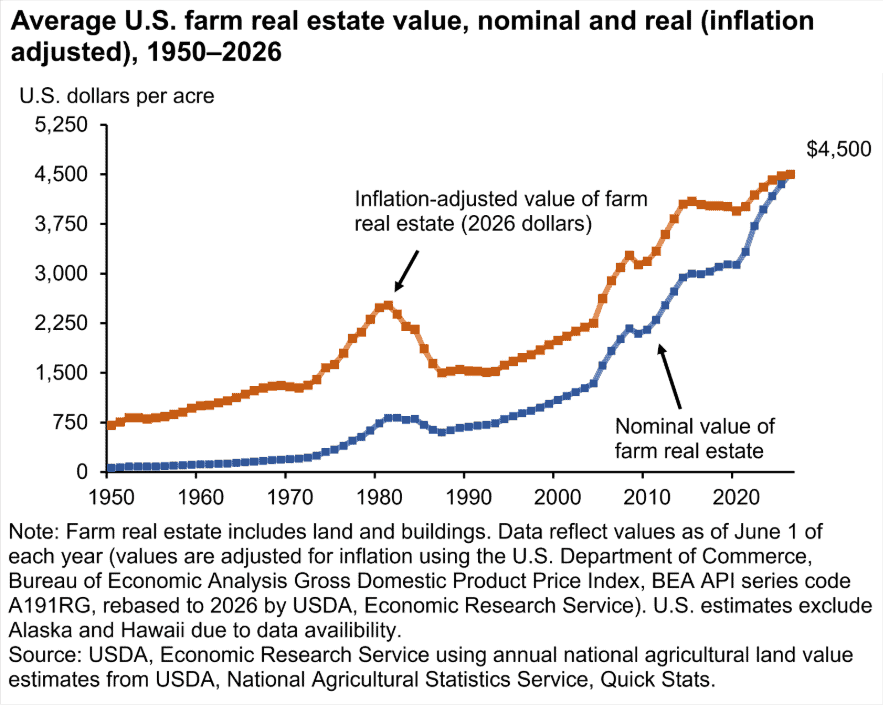
National averages, however, do not capture the full picture. Farmland is a highly localized asset, and values vary according to soil productivity, water availability, regional agricultural economics, property characteristics, and competition from other buyers.
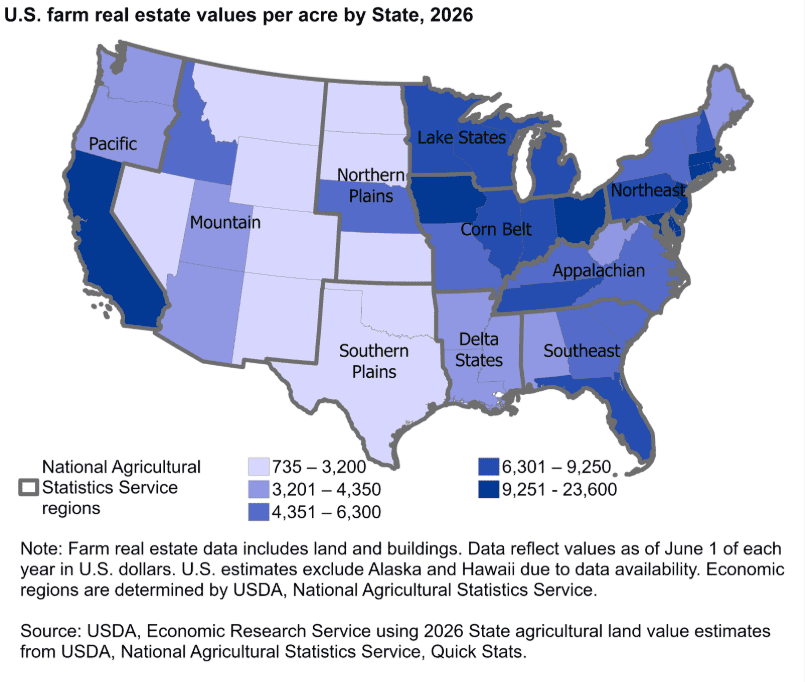
Competition from non-agricultural buyers can also affect farmland values. In some areas, development pressure, renewable energy projects, recreational demand, and other alternative land uses compete for a limited land base.
Bottom line: Resilient national farmland values do not mean every property is appreciating across the board. Understanding the value of your specific property is the first step in evaluating how it can support your operation’s broader financial goals.
The Biggest Misconception About Strong Land Values
Perhaps the most important distinction in today’s farmland market is the difference between balance sheet strength and available cash.
When farmland appreciates, an owner’s equity may increase if the property’s value rises relative to its outstanding debt. That equity can strengthen the balance sheet and potentially create additional financing options.
However, appreciation does not automatically generate cash or improve the profitability of an operation.
Consider an operation with $5 million in farmland equity that faces working capital constraints because of lower commodity prices, elevated input costs, or existing debt obligations. The operation may own valuable long-term assets while struggling to cover near-term expenses, purchase inputs, or absorb an unexpected disruption.
This is the difference between being asset-rich and cash-flow-rich.
- Land equity is the value of real estate owned after accounting for debt secured against it.
- Liquidity measures an operation’s ability to meet near-term obligations using available cash and other readily convertible assets.
- Repayment capacity reflects the operation’s ability to generate sufficient cash flow to meet scheduled debt payments and other obligations.
These measures are related, but they are not interchangeable.
A strong balance sheet can provide an important financial foundation. Yet an operation can still experience liquidity pressure if expenses rise faster than revenue, payments are delayed, or debt service consumes too much available cash.
Likewise, higher property values do not guarantee additional borrowing capacity. Financing decisions depend on factors such as appraised value, existing liens, loan structure, repayment capacity, and the borrower’s overall financial position.
The goal is to understand how accumulated equity fits into the broader financial picture rather than treating appreciation as a substitute for cash flow management.
How Today’s Farmland Values Affect Borrowing, Expansion, and Investment Decisions
Understanding market conditions is only the first step. But how do those conditions affect land acquisitions, borrowing, and investments?
Expansion and Land Acquisition Decisions
Higher land prices and borrowing costs can make acquisitions more demanding, even when a property offers long-term strategic value.
Before purchasing additional acreage, producers and landowners should consider expected production returns, rental income where applicable, existing debt obligations, working capital needs, and the full cost of financing.
Interest rates are particularly important because they affect both borrowing costs and the returns buyers need to justify a purchase. When rates rise, the same land price can produce a less favorable investment outcome, while higher debt payments can reduce available cash flow.
Is now a good time to buy farmland? There is no universal answer. A purchase may make sense when the property supports an operation’s long-term strategy, the valuation is realistic, and projected cash flow remains sufficient under less favorable conditions. When considering a land acquisition, it’s important to evaluate the individual property and your financial capacity rather than relying solely on appreciation expectations. Comparing purchase scenarios and stress-testing farm cash flow can help determine whether an acquisition remains manageable if yields, commodity prices, or input costs move against expectations.
Borrowing Capacity and Financing Opportunities
How do farmland values affect borrowing capacity? Higher property values can increase equity relative to outstanding debt, potentially supporting refinancing or additional financing options for qualified borrowers, subject to credit approval and other underwriting considerations. Actual borrowing capacity depends on appraised value, existing obligations, lender requirements, and the operation’s ability to repay the proposed financing.
For rural landowners, this may create an opportunity to review existing debt structures or evaluate whether financing could support a defined business objective, such as a cash-out operational loan.
Operational Investments and Growth Planning
Land equity may also factor into plans to improve an operation over time. Depending on the borrower’s financial position and available financing options, potential investments could include irrigation improvements, equipment storage, infrastructure upgrades, drainage, or projects designed to improve efficiency.
Each investment should be evaluated based on its expected contribution to the business. Will it reduce operating costs, increase productive capacity, address an operational bottleneck, or improve long-term resilience? Can the operation support the associated debt payments if the projected benefits take longer than expected to materialize?
If you’re considering an investment, access AgAmerica’s Five-Question Framework for Major Farm Financial Decisions to help evaluate how it could affect your operation’s flexibility, liquidity, and long-term financial resilience.
Why Today’s Farmland Market Holds Both Opportunity and Risk
Resilient farmland values create opportunities, but they also require careful financial management and a thoughtful approach.
Potential opportunities include:
- Stronger balance sheet equity following appreciation.
- Potential refinancing options for qualified borrowers.
- Improved collateral positions.
- Financing for strategic operational investments.
- Greater flexibility to evaluate long-term growth or transition plans.
Key risks include:
- Higher borrowing costs and reduced land affordability.
- Continued pressure on operating margins and repayment capacity.
- Overestimating the financial benefits of appreciation.
- Assuming strong asset values can compensate for insufficient working capital.
- Greater barriers for younger producers seeking to acquire land.
The most effective approach is to evaluate land values alongside working capital, operating profitability, debt obligations, and future capital needs. Appreciation can contribute to financial flexibility, but it should be one component of a broader strategy, not a substitute for financial discipline.
What Producers and Landowners Should Watch Going Forward
Rather than relying on a single prediction about where farmland prices are headed, here are several indicators to keep in mind when navigating changing market conditions.
- Interest rates: Borrowing costs influence land affordability, debt service, and the relative attractiveness of alternative investments.
- Farm profitability: Commodity prices, input costs, yields, and production expenses affect the income available to support land purchases and operating obligations.
- Working capital: Changes in liquidity can reveal financial pressure that land appreciation alone may not capture.
- Land supply: Available acreage and competition among buyers influence local pricing.
- Government support programs: Changes to crop insurance, commodity programs, and other assistance can influence farm income and risk management.
- Regional land demand: Agricultural returns, water availability, recreational interest, and development pressure can produce different outcomes across markets.
These indicators provide context for evaluating farmland market conditions, but none guarantees a particular price trajectory. It is best to combine market information with property-specific analysis to gain an accurate picture of the property under consideration.
Explore Ways to Leverage Land Equity for Greater Financial Flexibility
Despite a challenging farm economy, farmland remains a valuable asset for agricultural producers, offering a foundation for generational wealth, expanded productive capacity, and the opportunity to leverage equity and reinvest into your operation.
But it must be done right.
AgAmerica helps landowners evaluate how their real estate assets fit into broader financing goals, including potential refinancing and liquidity strategies. Any financing decision should account for repayment obligations, collateral requirements, and the operation’s long-term financial needs.
Whether you’re evaluating a land purchase, reviewing existing debt, planning an operational investment, or preparing for a generational transition, a proactive assessment of your financial position can help clarify your options.
Connect with an AgAmerica lending expert to discuss your goals, review your financial position, and explore financing options that may fit your operation.